ENGL 393A. The African American Historical Novel
What makes a novel historical? Is there a difference between history and fiction? What can fiction accomplish that history can’t?
This course examines the ways that African American authors have used the genre of the historical novel to address questions of race, national identity, and America’s fraught historical record. We begin with Frederick Douglass’s “The Heroic Slave” and conclude with Colson Whitehead’s Underground Railroad, published just this fall. Along the way, we consider the critical tools and frameworks best suited to analyzing the genre of the historical novel, as well as the theoretical implications of blending fictional and historical narrative modes.
Course Information
Fall 2016
MWF 3:35-4:30
Payne 212
Instructor Information
Washington 108
bufkins@wlu.edu
M and W 9:00-10:00
Tu 1:00-3:00
And by appointment
Course Objectives
Students in this class will learn how to
- write clear, persuasive analytical essays driven by arguments about texts;
- read closely, recognizing subtle and complex differences in language use;
- seek out further knowledge about literary works, authors, and contexts, and document research appropriately, adhering to the highest standards of intellectual honesty;
- broaden the range of literary texts and performances from which they can derive pleasure and edification;
- make connections between texts and across historical periods;
- identify, evaluate and contribute to disciplinary conversations.
Required Texts
- Brown, William Wells. Clotel. 1853. Ed. Geoffrey Sanborn. Peterborough: Broadview, 2016.
- Butler, Octavia. Kindred. 1979, Boston, Beacon: 2003.
- Douglass, Frederick. The Heroic Slave. 1852. Eds. Robert Levine, John Stauffer and John R. McKivigan. New Haven: Yale UP, 2015.
- Hopkins, Pauline. The Magazine Novels of Pauline Hopkins. New York: Oxford UP, 1988.
- Jones, Edward. The Known World. New York: Amistad, 2003.
- Jones, Tayari. Leaving Atlanta. New York: Warner Books, 2002.
- Morrison, Toni. Jazz. 1992. New York: Vintage, 2004.
- Walker, Margaret. Jubilee. 1966. Boston: Mariner Books, 1999.
- Whitehead, Colson. The Underground Railroad. New York: Doubleday, 2016.
The books are all available at the Washington and Lee University Store. All readings not listed above will be available on Sakai; you should print those readings out and bring them to class on the day they will be discussed.
Grading
 Grading scale
90-92 points A-
87-98 points B+
83-86 points B
80-82 points B-
77-79 points C+
70-72 points C-
67-69 points D+
63-66 points D
60-62 points D-
0-59 points F
Assignments
Close Reading
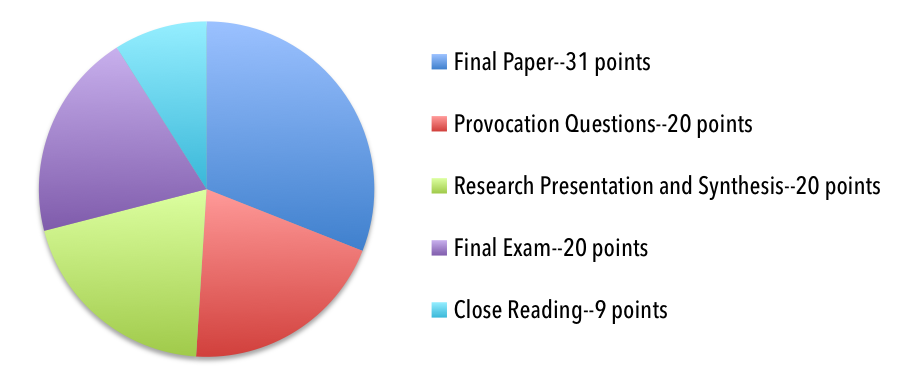
Literary analysis is grounded in close reading. Early in the term, you will write a short, focused close reading of an important passage in a text. The goal of this assignment is to look in depth at a small part of the text, rather than reflecting generally on the entirety. You should be able to identify a few paragraphs—a page at most—from which you will draw your evidence and focus your analysis. Your goal should be to connect the insights you draw from a short and well-defined section of the text to the work as a whole—that is, you will draw most of your evidence from a single passage, but your thesis and conclusion will attempt to show why your ideas about this one section are relevant to understanding the work as a whole.
Research Presentation and Synthesis
Once during the course of the term, you will be responsible for giving a research presentation about the author and text under discussion for the day. Your presentation should introduce the class to some historical or contextual issue that is relevant to our understanding of the text being discussed that day, as well as to the critical conversation surrounding that issue. In addition to an oral presentation of your findings, you will also post a bibliography and synthesis (1000-1500 words) of your research to the course blog.
Provocation Questions
Approximately once a week, you will be responsible for submitting a detailed, substantive question about some aspect of that day’s reading. At the beginning of the course, we will discuss what constitutes a detailed, substantive question, and I will provide several examples for you to refer to. At the beginning of the term, I will create a provocation question schedule. On your assigned dates, you will post your question to the course blog no later than midnight on the day before class meets. Over the course of the term, you will submit eleven provocation questions; I will average the top ten.
Final Paper
Your final paper will be a 3000-4500 word analytic research essay on a topic of your choosing. You have a great deal of latitude in the focus of your paper, so you should choose something that interests you and that you think will be beneficial to your academic goals. The form of the essay should be that of a critical analysis appropriate to the discipline of literary studies; however, if you have a different form in mind or would like to pursue a creative project, you are encouraged to discuss your ideas with me.
Prior to submitting your final paper, you will complete a paper proposal, which you will discuss with me during a paper conference. You will then submit a partial draft of your paper before Thanksgiving break. You should use the feedback from your paper conference and partial draft, as well as the resources your classmates provide in their context presentations, as you write your final paper.
Final Exam
Your final exam will be a 20-30 minute oral examination that asks you to synthesize the concepts, discussions and readings from the term. We will discuss what to expect from the exam, and you will have an opportunity to work with your classmates to draft potential examination questions. Oral examinations will take place during exam week; you will need to schedule your exam with me before the final day of class.
Course Policies
Class Blog
The blog for this course will serve as a place to extend and expand on our discussions in class. You will post your discussion questions to the blog, and you are encouraged to comment on your classmates’ questions. You will also post the materials for your context presentation to the blog. I will provide instructions for posting to the blog, but if you are having any difficulties, you are responsible for getting assistance, either from me or from campus ITS.
Attendance
Much of the work of this class will be accomplished in discussion, which means your attendance and participation are essential. You may have one no-questions-asked absence during the semester; after that, any absences must be explained and, in some cases, documented. Excessive absences will negatively affect your grade, and more than six absences (two full weeks of class) will result in a failing grade for the course.
Technology
Classroom engagement and active discussion are essential parts of this course. For that reason, I ask that you consider carefully your use of technology and whether it serves as a distraction from your participation and attention to your classmates. If using a laptop or tablet is a marked aid to your note-taking process, then you may do so, but I encourage you to put electronic devices away whenever possible. In addition, there should be no audio or visual recording of the class without my explicit permission and that of your classmates.
Plagiarism
Washington and Lee defines plagiarism as “the use of another’s words or ideas without proper acknowledgment.” You are responsible for familiarizing yourself with what constitutes plagiarism and how to avoid it. For assistance, see the resources available on the library website and consult with me during my office hours.
Accommodations for Students With Disabilities
Washington and Lee University makes reasonable academic accommodations for qualified students with disabilities. All undergraduate accommodations must be approved through the Office of the Dean of the College. Students requesting accommodations for this course should present an official accommodation letter within the first two weeks of the term and schedule a meeting outside of class time to discuss accommodations. It is the student’s responsibility to present this paperwork in a timely fashion and to follow up about accommodation arrangements. Accommodations for test-taking should be arranged with the professor at least a week before the date of the test or exam. For more information contact: Wendy L. Price, Assistant Dean of the College, Lee-Jackson House (540) 458-8746.